Ditapis dengan
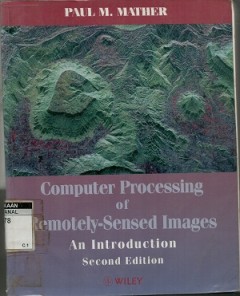
Computer processing of remotely sensed images
- Edisi
- -
- ISBN/ISSN
- 0-471-98550-3
- Deskripsi Fisik
- xvii, 234 hlm. illus. 24 cm.
- Judul Seri
- -
- No. Panggil
- 621.3678 PAU c
- Edisi
- -
- ISBN/ISSN
- 0-471-98550-3
- Deskripsi Fisik
- xvii, 234 hlm. illus. 24 cm.
- Judul Seri
- -
- No. Panggil
- 621.3678 PAU c

Principles of Remote Sensing
- Edisi
- -
- ISBN/ISSN
- 90-6164-183-7
- Deskripsi Fisik
- -
- Judul Seri
- 170 hlm
- No. Panggil
- 621.3678 WIM p
- Edisi
- -
- ISBN/ISSN
- 90-6164-183-7
- Deskripsi Fisik
- -
- Judul Seri
- 170 hlm
- No. Panggil
- 621.3678 WIM p
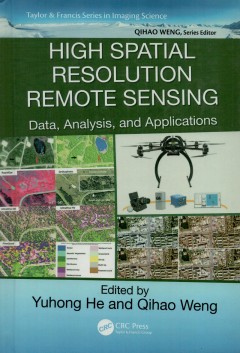
High spatial resolution remote sensing: data, analysis and applications
- Edisi
- -
- ISBN/ISSN
- 978-1-4987-6768-2
- Deskripsi Fisik
- 375 hlm. : illus. ; 24 cm.
- Judul Seri
- -
- No. Panggil
- 621.3678 YUH h
- Edisi
- -
- ISBN/ISSN
- 978-1-4987-6768-2
- Deskripsi Fisik
- 375 hlm. : illus. ; 24 cm.
- Judul Seri
- -
- No. Panggil
- 621.3678 YUH h
The Sage Handbook of Remote Sensing
- Edisi
- -
- ISBN/ISSN
- 978-1-4129-3616-3
- Deskripsi Fisik
- xiv, 536 hlm
- Judul Seri
- -
- No. Panggil
- 621.3678 TIM s
- Edisi
- -
- ISBN/ISSN
- 978-1-4129-3616-3
- Deskripsi Fisik
- xiv, 536 hlm
- Judul Seri
- -
- No. Panggil
- 621.3678 TIM s
Proceeding Mapping and Remote Sensing tools for the 21st Century, Conference …
- Edisi
- -
- ISBN/ISSN
- 1-57083-012-6
- Deskripsi Fisik
- vii, 240 hlm. : illus.
- Judul Seri
- -
- No. Panggil
- 621.3678 UNI p
- Edisi
- -
- ISBN/ISSN
- 1-57083-012-6
- Deskripsi Fisik
- vii, 240 hlm. : illus.
- Judul Seri
- -
- No. Panggil
- 621.3678 UNI p

Vegetation Monitoring of Palm Trees in an Oasis Environment (Boudenib, Morocc…
Oases are part of the natural wealth and heritage of Morocco and contribute to the social, economic, and touristic environment. Morocco has lost more than 2/3 of its oases during the past century due to water scarcity, succession of drought periods, climate change and over-exploitation of groundwater resources. Palm trees are strongly dependent on irrigation and availability of surface water as…
- Edisi
- Vol.15, Issue 3, March 2025
- ISBN/ISSN
- 2076-3263
- Deskripsi Fisik
- 29 hlm PDF, 3.816 KB
- Judul Seri
- Geosciences
- No. Panggil
- 550

Remote Sensing and Geophysical Applications in the Dead Sea Region: Insights,…
The Dead Sea ecosystem, with its hypersaline conditions, base-level fluctuations, and active tectonics, presents a unique challenge for geological studies. Its equilibrium is increasingly unbalanced due to overexploitation of water and mineral resources. Remote sensing, including drone-based photogrammetry and satellite imaging, monitors large-scale surface changes, while geophysical methods li…
- Edisi
- Vol.15, Issue 2, February 2025
- ISBN/ISSN
- 2076-3263
- Deskripsi Fisik
- 24 hlm PDF, 1.726 KB
- Judul Seri
- Geosciences
- No. Panggil
- 550

Mapping of Agate-like Soil Cover Structures Based on a Multitemporal Soil Lin…
The present study focuses on analysis of the soil cover structure (SCS, SCSs), which is the most detailed level of soil organization in space. The detail in which complex SCS can be studied is often insufficient, since until now it has not been possible to map it over large areas at scales larger than 1:10,000. To increase the detail in which SCS can be studied, the methods of identifying the b…
- Edisi
- Vol.15, Issue 1, January 2025
- ISBN/ISSN
- 2076-3263
- Deskripsi Fisik
- 24 hlm PDF, 5.793 KB
- Judul Seri
- Geosciences
- No. Panggil
- 550

Impacts of Land Use on Soil Erosion: RUSLE Analysis in a Sub-Basin of the Per…
The Peruvian Amazon faces an increasing threat of soil erosion, driven by unsustainable agricultural practices and accelerated deforestation. In Neshuya (Ucayali region), agricultural activity has intensified since 2014, but the effect on soil erosion is unknown. The present study aimed to evaluate the increase in erosion levels, at a sub-basin of the central–eastern Amazon of Peru, in a Geog…
- Edisi
- Vol.15, Issue 1, January 2025
- ISBN/ISSN
- 2076-3263
- Deskripsi Fisik
- 31 hlm PDF, 8.832 KB
- Judul Seri
- Geosciences
- No. Panggil
- 550

ASTER data processing and fusion for alteration minerals and silicification d…
Alteration minerals and silicification are typically associated with a variety of ore mineralizations and could be detected using multispectral remote sensing sensors as indicators for mineral exploration. In this investigation, the Visible Near-Infra-Red (VNIR), Short-Wave Infra-Red (SWIR), and Thermal Infra-Red (TIR) bands of the ASTER satellite sensor derived layers were fused to detect alte…
- Edisi
- Vol.5, December 2024
- ISBN/ISSN
- 2666-5441
- Deskripsi Fisik
- -
- Judul Seri
- -
- No. Panggil
- 18 hlm PDF, 39.870 KB
 Batas Wilayah
 Ekologi
 Fotogrametri
 Geografi
 Geologi
 GIS
 Ilmu Tanah
 Kartografi
 Manajemen Bencana
 Oceanografi
 Penginderaan Jauh
 Peta