Ditapis dengan

Next generation geospatial information: from digital image analysis to spatio…
- Edisi
- -
- ISBN/ISSN
- 0-415-08851-4
- Deskripsi Fisik
- 226 hlm. illus.
- Judul Seri
- -
- No. Panggil
- 910.285 Peg N
- Edisi
- -
- ISBN/ISSN
- 0-415-08851-4
- Deskripsi Fisik
- 226 hlm. illus.
- Judul Seri
- -
- No. Panggil
- 910.285 Peg N
Internet GIS: distributed geographic information services for the internet an…
Internet GIS addresses a suite of emerging new technologies aimed at making GIS moe mobile, powerful, and flexible, as well as better able to share and communicate geographic information. This groundbreaking book is the first of its kind to troroughly cover basic internet GIS issues such as state of the art technology, implementation practices, applications, and data, as well as future trends …
- Edisi
- -
- ISBN/ISSN
- 0-471-35923-8
- Deskripsi Fisik
- xxxvi, 679 hlm. ; illus. ; 24 cm.
- Judul Seri
- -
- No. Panggil
- HK 910.0285 ZHO i
Penelitian dan pemanfaatan data spasial Bakosurtanal: laporan ilmiah
- Edisi
- -
- ISBN/ISSN
- 978-979-26-9626-8
- Deskripsi Fisik
- 129 hlm. : illus.
- Judul Seri
- -
- No. Panggil
- Buku.Karya 2007/17.III DAD p
- Edisi
- -
- ISBN/ISSN
- 978-979-26-9626-8
- Deskripsi Fisik
- 129 hlm. : illus.
- Judul Seri
- -
- No. Panggil
- Buku.Karya 2007/17.III DAD p
Buku panduan forum komunikasi kediklatan sosialisasi standar pelayanan diklat…
- Edisi
- -
- ISBN/ISSN
- -
- Deskripsi Fisik
- 35 hlm. : illus. ; 29 cm.
- Judul Seri
- -
- No. Panggil
- Buku.Karya 2013/101.VII BUD b
- Edisi
- -
- ISBN/ISSN
- -
- Deskripsi Fisik
- 35 hlm. : illus. ; 29 cm.
- Judul Seri
- -
- No. Panggil
- Buku.Karya 2013/101.VII BUD b
Gis fundamentals :A first text on geographic information systems
This book provides an introduction to the theory and application of GIS. it is written for us in an introductory GIS class and as a reference for the GIS practitioner. this fifth edition blances theoretical and applied material, so that students my apply knowledge of GIS in the solution of real-world problems. improvemets over the previous editions are include an each chapter. topics treated in…
- Edisi
- -
- ISBN/ISSN
- 9781506695877
- Deskripsi Fisik
- xiv, 769 hlm, ilius, 25,5 cm
- Judul Seri
- -
- No. Panggil
- 910.285 PAU g

Advances in spatial data handling and analysis : select papers from the 16th …
Thiss volume includes top papers from the 2014 International Symposium on Spatial Data HAndling and covers Web and Crowd-sourcing GI, Network Analysis, Spatial Modeling and Reasoning, and statistical and Spatial Analysis. The Symposium is the premier long-running forum in geographical information science, providing a prestigious outlet to geographers, cartographers, computer scientists and ot…
- Edisi
- -
- ISBN/ISSN
- 978-3-319-19949-8
- Deskripsi Fisik
- xiv, 320 hlm. : illus. ; 24 cm.
- Judul Seri
- Advanced in Geographic Information Science
- No. Panggil
- 910.0285 FRA a

Geospatial technologies and geography educationina chaging wordl: geospatial …
This book is an initiative presented by the commission on Geographical eduation of the International Geographical Union. It focuses particulary on what has been learned from geospatial projects and research from the past decades of implementing geospatial technologies (GST) in formal and informal education. The objective of this publication is to inform an international audience of teachers,…
- Edisi
- -
- ISBN/ISSN
- 978-4-431-55519-3
- Deskripsi Fisik
- xxi, 221 hlm : illus. ; 24 cm.
- Judul Seri
- -
- No. Panggil
- 910.0285 OSV g
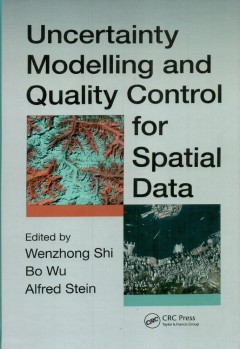
Uncertainty modelling and quality control for spatial data
This book focused on major research relative to spatial information, and this book introduces methods for managing uncertainties - such as data of questionable quality - in geographic information science (GIS) applications. By using original research, current advancement, and emerging developments in the field, the authors compile various aspects of spatial data quality control, From multidime…
- Edisi
- -
- ISBN/ISSN
- 978-1-4987-3328-1
- Deskripsi Fisik
- vix, 283 hlm. : ilus. ; 24 cm.
- Judul Seri
- -
- No. Panggil
- 910.0285 WEN u
Geographic information system for geoscientists: modelling with GIS
- Edisi
- -
- ISBN/ISSN
- 0-08-041867-8
- Deskripsi Fisik
- xvii, 398 hlm. illus. 28 cm.
- Judul Seri
- -
- No. Panggil
- 910.285 Gra G
- Edisi
- -
- ISBN/ISSN
- 0-08-041867-8
- Deskripsi Fisik
- xvii, 398 hlm. illus. 28 cm.
- Judul Seri
- -
- No. Panggil
- 910.285 Gra G

Python for ArcGIS
This book is aimedprimarily at teaching GIS Phyton scripting to GIS users who have little or no Python programming experience. Topicsareorganized to build upon each other, so forthis audience, reading the chapters sequentially is recommended. Computer programmers who are not familiarwith ArcGIS can also use this book to learn toautomated GIS analyses with the ArcGIS Phyton API, accessible thro…
- Edisi
- -
- ISBN/ISSN
- 978-3-319-18397-8
- Deskripsi Fisik
- xvi, 538 hlm. : illus. ;23 cm.
- Judul Seri
- -
- No. Panggil
- 910.0285 LAU p
 Batas Wilayah
 Ekologi
 Fotogrametri
 Geografi
 Geologi
 GIS
 Ilmu Tanah
 Kartografi
 Manajemen Bencana
 Oceanografi
 Penginderaan Jauh
 Peta